Sun Images for Past 72 Hours
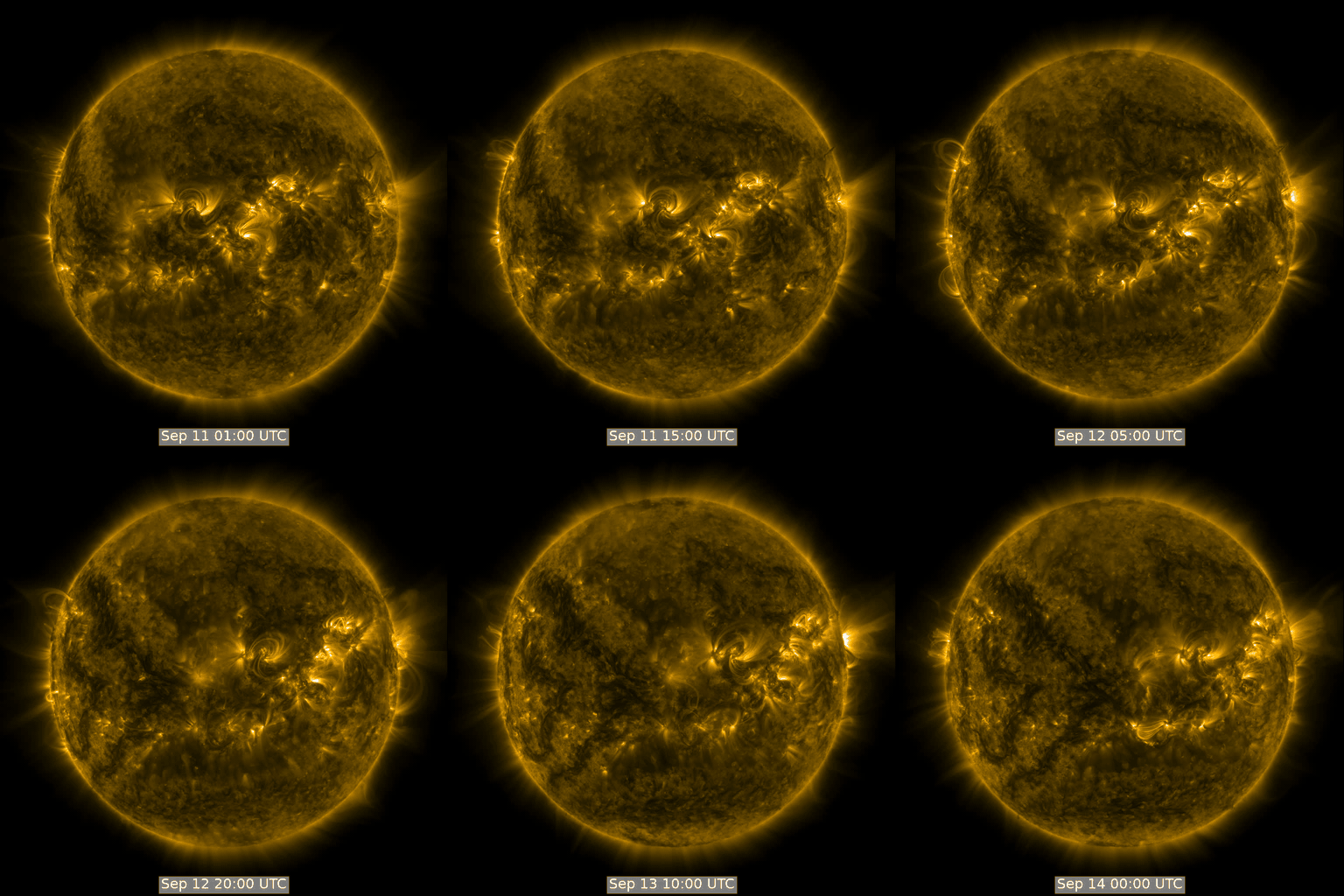
Images copyrighted by the SDO/NASA and Helioviewer project
📋 Propagation Summary: Today’s HF propagation is shaped by moderate solar activity with a solar flux of 114 and a sunspot number of 77, both slightly lower than recent months. Geomagnetic conditions are very quiet (K-index 0), which is excellent for stable HF operation and low noise. Expect good performance on 80m, 40m, and 20m, with higher bands (15m, 12m, 10m) less reliable due to lower solar flux. Operators should focus on low and mid bands for reliable contacts, especially during local day and night. No major space weather alerts—today is a great day for HF!
💡 Operator Tips
- Prioritize 80m, 40m, and 20m for both local and DX contacts—these bands are showing the most consistent propagation.
- Digital modes (FT8, PSK31) will outperform SSB/CW on higher bands (15m, 12m, 10m) due to weaker conditions.
- Low noise levels (K=0) mean even modest antennas and lower power should work well, especially on 40m and 20m.
- Check grayline times for enhanced DX, especially on 40m and 20m.
- For contesters: Focus on 20m during the day and 40m at night for best rates.
⏰ Best Operating Times
- 80m & 40m: Best at night and early morning for both local and regional contacts.
- 20m: Good all day, with peaks around late morning and afternoon for DX.
- 17m & 15m: Fair during midday; try late morning to early afternoon for possible openings.
- 12m & 10m: Poor throughout the day; only attempt during local noon or if you spot openings on cluster.
🌍 DX Opportunities
- Grayline enhancement on 40m and 20m—watch sunrise/sunset for long-haul DX.
- 20m offers the most reliable daytime DX, especially on north-south paths.
- 15m and 17m may open for short periods, especially toward equatorial regions.
- Aurora activity is low—no special VHF/UHF auroral propagation expected.
- No major solar events—stable conditions favor planned skeds and nets.
📻 Band-by-Band Analysis
| Band | Morning | Day | Evening | Night |
|---|---|---|---|---|
| 80m | 🟡 Good | 🟠 Fair | 🟡 Good | 🟢 Excellent |
| 40m | 🟡 Good | 🟡 Good | 🟢 Excellent | 🟢 Excellent |
| 20m | 🟡 Good | 🟡 Good | 🟡 Good | 🟠 Fair |
| 17m | 🟠 Fair | 🟠 Fair | 🟠 Fair | 🔴 Poor |
| 15m | 🟠 Fair | 🟠 Fair | 🔴 Poor | 🔴 Poor |
| 12m | 🔴 Poor | 🔴 Poor | 🔴 Poor | ⚫ Closed |
| 10m | 🔴 Poor | 🔴 Poor | ⚫ Closed | ⚫ Closed |
80m and 40m are the most reliable bands, especially at night and early morning. 20m remains solid for daytime DX. 17m and 15m may provide sporadic openings, mainly midday. 12m and 10m are mostly closed—monitor for brief openings but expect little activity.
📊 Current Solar Activity
Solar Activity Metrics
K-index
Solar Flux (10.7cm)
Sunspot Number
- K-index: 0 — Very quiet geomagnetic field, ideal for low noise and stable propagation.
- Solar Flux: 114 — Moderate level, supports good conditions on lower/mid bands but limits higher bands.
- Sunspot Number: 77 — Slightly below average for the cycle, consistent with moderate propagation.
- No major solar flares or disturbances reported.
📈 Geomagnetic Conditions
- Recent K-index trend: Stable at very low levels (K=0) over the past 24 hours.
- Impact: Excellent for HF—minimal absorption, low noise, and no auroral disruptions.
- Outlook: No geomagnetic storms expected; conditions should remain stable.
🌟 Space Weather Details
Space Weather Dashboard
X-ray Activity
Solar Wind Speed
Aurora Activity
- X-ray Activity: B4.1 (low)—no risk of HF blackouts; stable D-layer absorption.
- Solar Wind: 440.8 km/s—moderate, but not enough to trigger geomagnetic storms.
- Particle Environment: Electron flux 1810, Proton flux 15—both within normal range; no radio blackout risk.
- Aurora Activity: Level 2 (very low)—no VHF/UHF auroral propagation expected.
- Helium Line: 113.4—indicates steady solar activity, no major upswings or flares.
📡 Propagation Timeline & Technical Details
Propagation Quality Timeline (24 Hours)
- Recent solar trend: Solar flux and sunspot numbers have declined slightly over the past two months, from a peak in June/July (solar flux ~136, SSN ~78) to current moderate values.
- Implication: HF conditions are stable but not at their best; expect reliable low/mid-band operation, with fewer high-band openings.
Solar Activity Trends (6 Months)
🔮 3-Day Forecast