Sun Images for Past 72 Hours
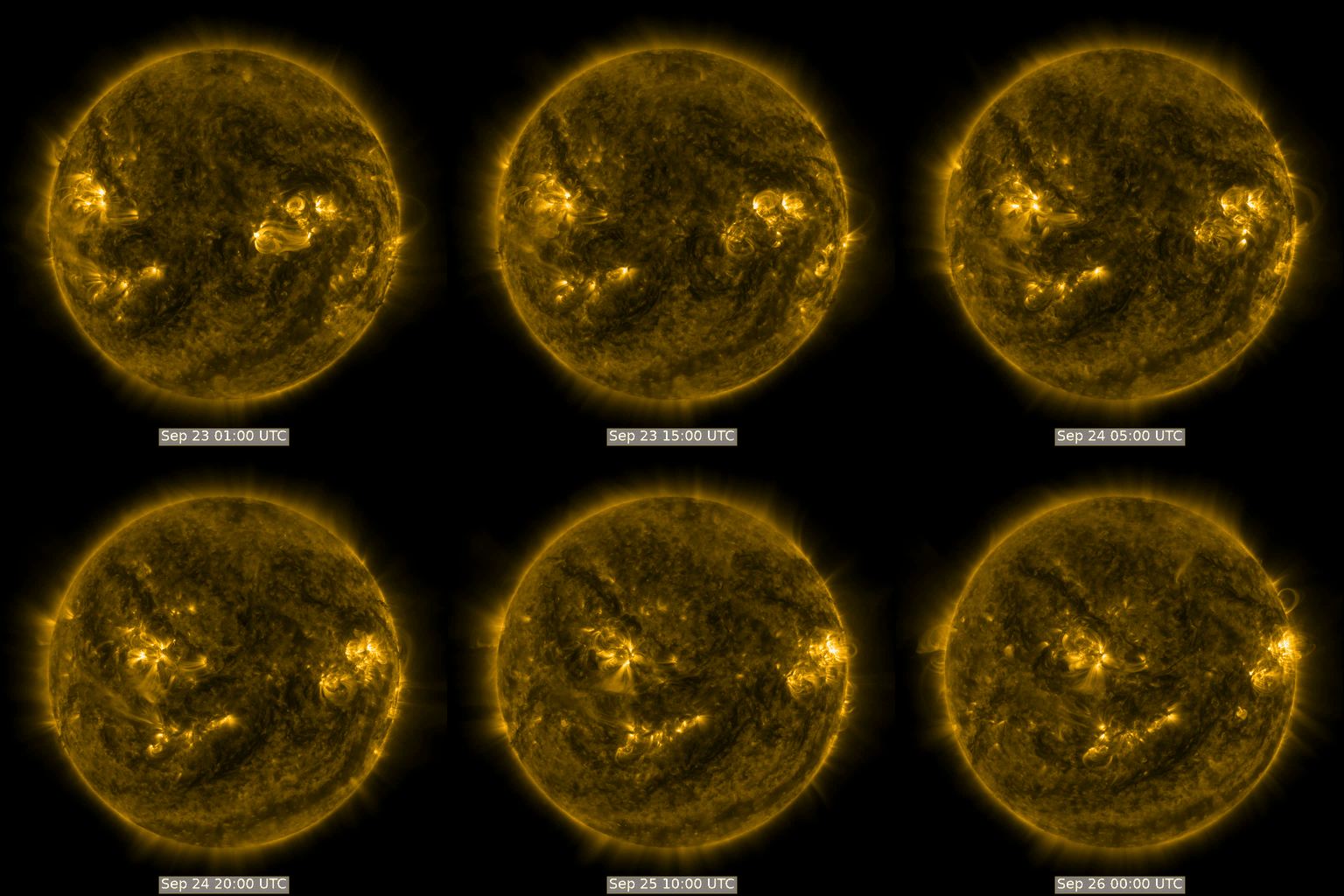
Images copyrighted by the SDO/NASA and Helioviewer project
📋 Propagation Summary
Today’s HF propagation is shaped by moderate solar activity and quiet geomagnetic conditions. The solar flux is at 105, with a sunspot number of 110, indicating average ionospheric support for HF. Most bands from 80m to 20m are open, but higher bands (15m-10m) are experiencing fair to poor conditions due to the recent dip in solar flux and sunspot numbers. Geomagnetic activity is low (K-index 2), so expect stable propagation with minimal disturbances. For best results, focus on the lower and mid bands, and time your operations for periods of enhanced band openings.
💡 Operator Tips
- Prioritize 20m and 40m for reliable daytime and evening contacts; these bands are currently the most consistent.
- Use digital modes (FT8, PSK31) on higher bands (15m-10m) to maximize weak signal performance.
- Monitor grayline periods for enhanced DX, especially on 40m and 20m.
- Check for short-skip on 20m and 17m during the afternoon.
- Portable and low-power operators: Take advantage of the quiet geomagnetic field for less noise on the lower bands.
- Contest/DXers: Focus on 20m for daytime DX and 40m for night-time intercontinental openings.
⏰ Best Operating Times
- 80m/40m: Best at night and early morning; fair during the day.
- 20m: Good all day and into the evening.
- 17m/15m: Fair throughout the day; limited at night.
- 12m/10m: Poor both day and night; check for sporadic E openings during local midday.
- Grayline (sunrise/sunset): Enhanced propagation on 40m and 20m for long-haul DX.
🌍 DX Opportunities
- Grayline paths: Excellent for 40m and 20m DX, especially to antipodal regions.
- 20m band: Offers the most consistent global coverage, especially during daylight.
- 17m/15m: Watch for brief DX openings, especially around local noon.
- Aurora activity is low (Aurora index 4), so VHF auroral propagation is unlikely.
- No major solar flares or geomagnetic storms expected, so DX windows should remain stable.
📻 Band-by-Band Analysis
| Band | Morning | Day | Evening | Night |
|---|---|---|---|---|
| 80m | 🟡 Good | 🟠 Fair | 🟡 Good | 🟡 Good |
| 40m | 🟡 Good | 🟠 Fair | 🟡 Good | 🟡 Good |
| 20m | 🟡 Good | 🟡 Good | 🟡 Good | 🟡 Good |
| 17m | 🟠 Fair | 🟠 Fair | 🟠 Fair | 🟠 Fair |
| 15m | 🟠 Fair | 🟠 Fair | 🟠 Fair | 🟠 Fair |
| 12m | 🔴 Poor | 🔴 Poor | 🔴 Poor | 🔴 Poor |
| 10m | 🔴 Poor | 🔴 Poor | 🔴 Poor | 🔴 Poor |
Analysis:
- 20m is the most reliable band throughout the day and evening, offering good regional and DX opportunities.
- 40m and 80m are best at night and early morning, with fair daytime performance.
- 17m and 15m are marginal but may yield contacts during daylight, especially with digital modes.
- 12m and 10m are mostly closed; only check for openings during strong solar events or sporadic E.
- For DX, focus on 20m during the day and 40m at night.
📊 Current Solar Activity
Solar Activity Metrics
K-index
Solar Flux (10.7cm)
Sunspot Number
- K-index: 2 (quiet geomagnetic field) – minimal disturbances, stable HF propagation.
- Solar Flux: 105 (moderate) – supports 20m and lower bands, but higher bands are limited.
- Sunspot Number: 110 (average) – enough for decent propagation, but not enough for strong high-band openings.
- Space Weather: No major flares or storms; X-ray flux at B4.8 (low), so blackout risk is minimal.
📈 Geomagnetic Conditions
- The K-index has remained low (around 2) over the past 24 hours, indicating stable geomagnetic conditions.
- No significant geomagnetic storms or sudden increases detected.
- Expect continued quiet conditions unless a solar wind shock arrives.
🌟 Space Weather Details
Space Weather Dashboard
X-ray Activity
Solar Wind Speed
Aurora Activity
- X-ray Activity: B4.8 (low) – No risk of HF blackouts; stable D-layer absorption.
- Solar Wind Speed: 476.8 km/s – Slightly elevated, but not enough to trigger geomagnetic disturbances.
- Electron Flux: 1600 – Moderate; may cause minor polar absorption but not a major factor.
- Proton Flux: 12 – Low; no radiation storm risk.
- Aurora: 4 – Quiet; no auroral propagation expected on VHF/UHF.
- Helium Line: 110.9 – Indicates moderate solar activity; trend is steady, not rising.
📡 Propagation Timeline & Technical Details
Propagation Quality Timeline (24 Hours)
- Over the past 6 months, solar flux has trended downward from a high of 138 in June to 116 in August.
- Sunspot numbers have also decreased, reflecting a softening in high-band propagation.
- This trend suggests that 20m and lower bands will continue to be the most reliable, with high bands (15m-10m) opening only during brief solar upticks.
Solar Activity Trends (6 Months)
🔮 3-Day Forecast